Granola: AI to turn meetings into useful notes
Granola combines a meeting transcript with your own notes to organize what was discussed.
Voices depend on your browser and device; some require internet access. Code blocks are not read aloud.
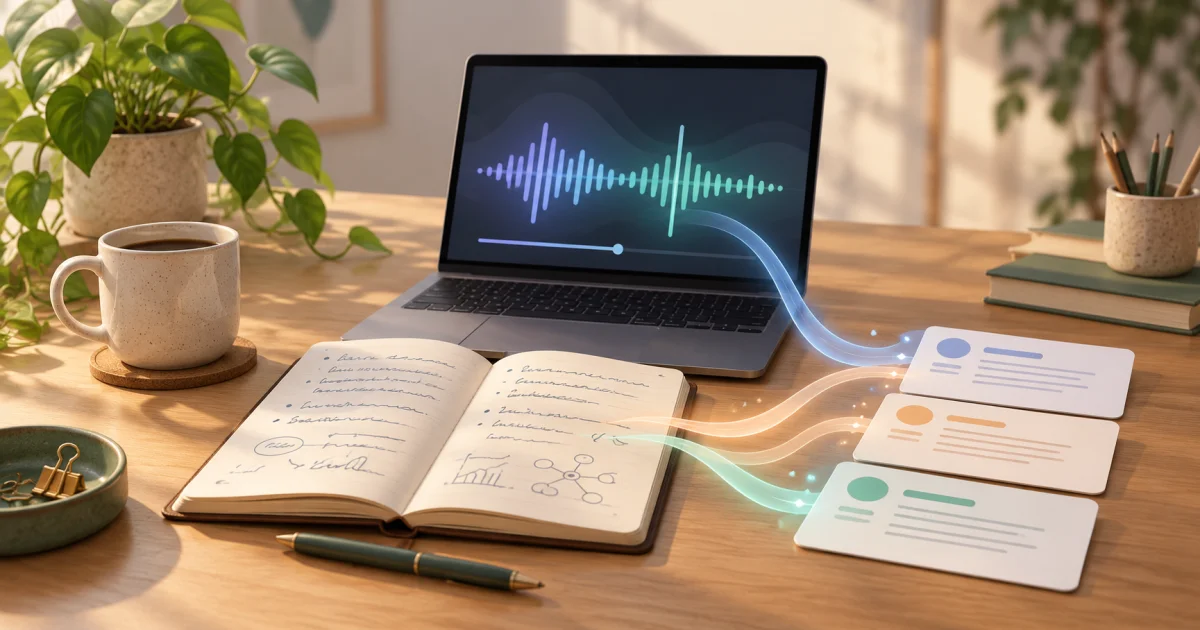
The meeting ends, and your notes say only: “deadline,” “check budget,” and “talk to the team.” At the time, it all made perfect sense. Two hours later, you already need to reconstruct the conversation. Granola was designed to help bridge the gap between taking part in a meeting and keeping a useful record of it.
Granola presents itself as an AI notepad. You can write down the points you consider important while the tool uses the conversation to complete and organize the record.
Your notes help provide direction
The documentation on AI-enhanced notes explains that the result combines the transcript, the user's written notes, and information from the calendar event.
Afterward, you can edit the text or request adjustments. The tool also lets you investigate which part of the transcript or notes a particular point came from. That path back to the conversation is useful when a summarized sentence leaves some uncertainty.
The important detail is that your notes still have a role: they signal what caught your attention during the meeting.
How the conversation enters the process
On a computer, Granola uses system audio and the microphone without adding a bot participant to the call. The explanation of transcription clarifies that you need to open the corresponding note to start this process.
This calls for a simple habit: check when transcription has started and stop it when you are done, especially between back-to-back meetings. It also makes sense to agree on its use with participants and respect the team's practices for recording conversations.
An example to picture
Imagine an illustrative meeting about launching a website. During the conversation, you write down “confirm date” and “review copy.” At the end, you use the organized record to check what was decided and what is still pending.
The review should distinguish a suggestion from an approved decision. “Maybe we could launch on Friday” does not mean “launch confirmed for Friday.” Names, owners, and dates deserve special attention before sharing the summary.
Why it is worth following
Granola stands out for trying to preserve human participation in the conversation while making the notes more useful afterward. For people moving between many meetings, it can be helpful to have a record that makes it easier to pick up topics again without relying on memory.
I would assess the tool in a meeting with a simple agenda: I would compare my notes, the summary, and the source passages. The criterion would be clear: can I understand what happened and continue the work with less effort spent reconstructing it?
If the answer is yes, the notepad starts to serve a very practical purpose: helping the conversation lead to next steps.
Official sources consulted on October 21, 2026.