Liquid AI: models that bring intelligence directly to devices
Liquid AI develops models focused on efficiency and on-device execution, along with options for cloud use.
Voices depend on your browser and device; some require internet access. Code blocks are not read aloud.
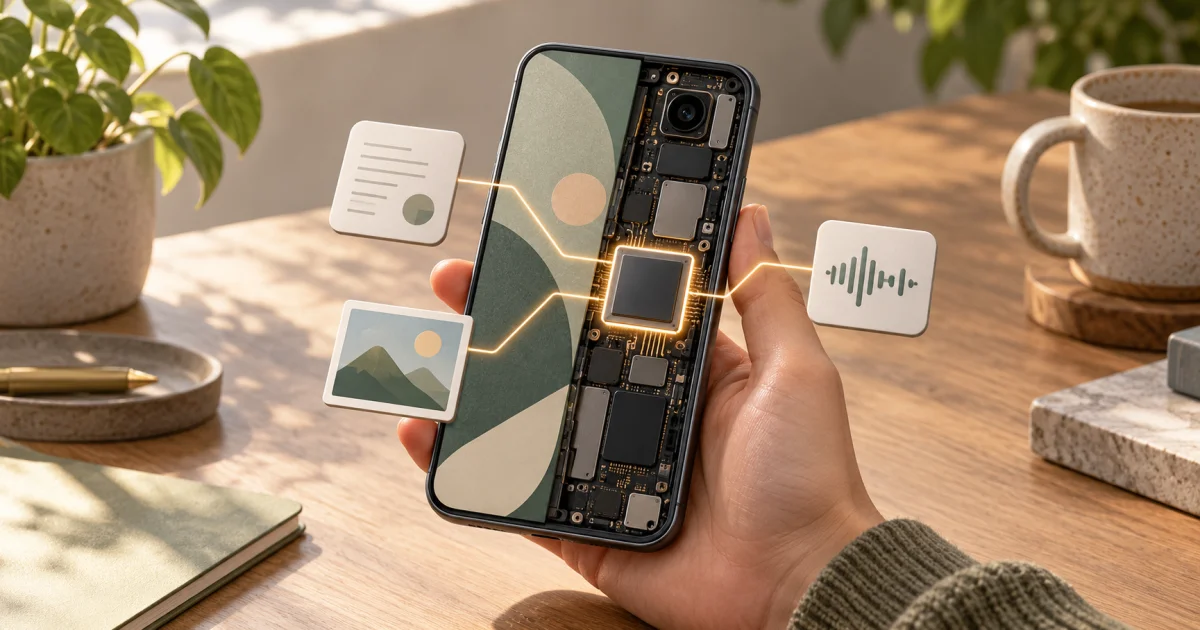
An AI feature can look simple on the screen: you ask a question and receive an answer. Behind the scenes, however, there is an important choice about where that processing happens. In some projects, it makes sense to bring it closer to the device itself.
Liquid AI develops models focused on efficiency and on-device execution. Its approach takes real constraints into account, such as available memory, response time, and processing capacity.
What does the company offer?
A model is the AI component that receives information and produces results within an application. It is a building block developers can use to create products.
The Liquid AI catalog brings together families designed for text, vision, audio, and specific tasks. It also presents paths for local execution and use in cloud services. The choice depends on the model and the project.
This matters because “on-device AI” does not mean that any model fits on any phone. The model's size, the software that runs it, and the device's resources need to work together.
How might this idea appear in everyday life?
Think of an illustrative scenario: a team wants to create an assistant for consulting technical instructions stored on a device used in the field. The product needs to work in conditions where connectivity can vary.
A locally running model could be part of that solution, provided the necessary documents and other components were also available on the device. The team would need to test response quality, memory use, and energy consumption on the actual equipment.
The example shows the appeal of the approach: choosing where the intelligence will run according to the product's needs.
From promise to development
The documentation for mobile applications shows how to integrate LFM models into iOS and Android applications using llama.cpp, a library for running models. It also covers adjustments and evaluation on the hardware.
For readers who do not program, the central point is that this requires integration work. The final experience depends as much on the model as on the application built around it.
Why it is worth following
Liquid AI stands out for exploring what AI can do under concrete constraints. Not every product needs to use the same architecture or depend on the same type of infrastructure.
The first test should start with a small task and devices representative of those used by the users. The evaluation needs to balance useful responses, speed, memory, and battery life, as well as the model's license terms.
Running locally can help reduce the amount of information sent for external processing, but the entire application needs to be analyzed to understand its data flow. It is in this combination of model, device, and product that Liquid AI's approach becomes especially interesting.
Official sources consulted on October 21, 2026.