Tamarind Bio: AI tools for protein researchers
Tamarind Bio brings together computational models for biotechnology research. See how the platform can help explore hypotheses about proteins.
Voices depend on your browser and device; some require internet access. Code blocks are not read aloud.
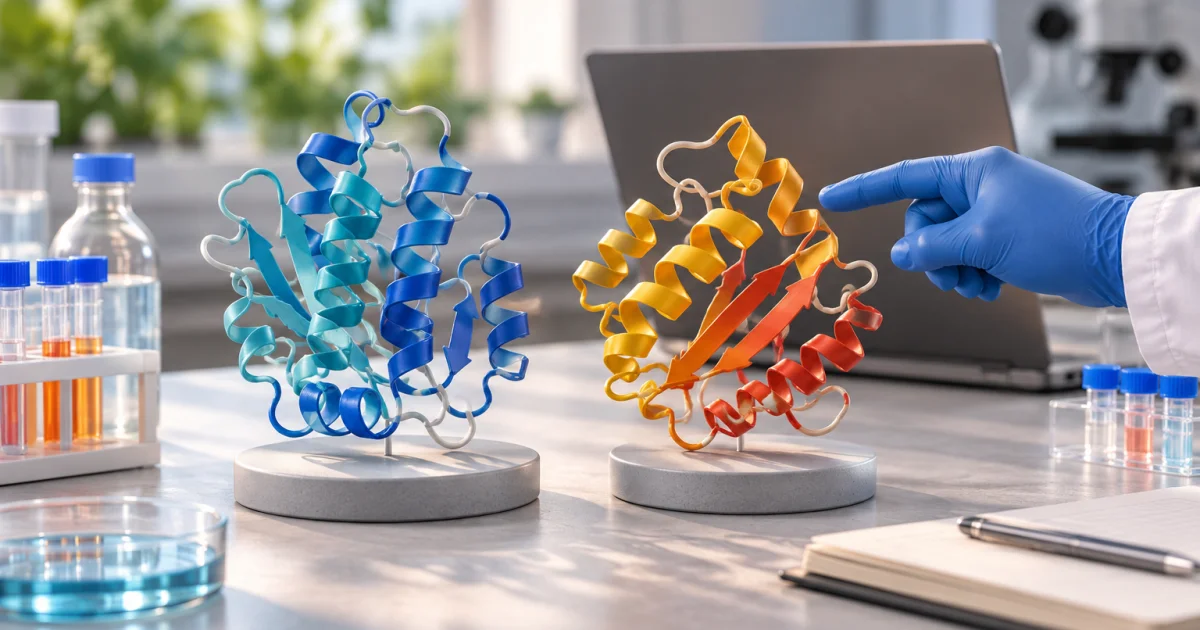
Researching a protein involves questions that go far beyond its name. What is its structure? How might it interact with other molecules? Which possibilities deserve a closer look?
Tamarind Bio brings together computational tools to support this work. The platform is aimed at biotechnology research and presents applications involving proteins, antibodies, enzymes, and other molecules. The idea is to make specialized methods easier to access in a single environment. Explore the official overview.
A toolbox for research
The methods presented include AlphaFold, RFdiffusion, and ProteinMPNN, associated with different protein prediction and design tasks. Tamarind provides a web interface and API access, an interface that connects its resources to other programs and research processes.
To picture this, think of proteins as molecules whose shape and characteristics influence what they do. Computational models seek to estimate aspects of this behavior or suggest possibilities that researchers will then analyze. Tamarind's guide to AI for proteins explores this area in more detail.
Where can this help?
Imagine a team that wants to compare candidates before deciding which will move on to an experimental stage. In this illustrative scenario, the platform could bring together computational analyses that help organize the hypotheses.
The interest lies in making comparison more accessible and allowing the team to focus on the scientific questions. Choosing the right method, interpreting the result, and understanding uncertainty remain part of the research work.
A predicted structure or a favorable computational assessment still needs to be put to the test. On their own, these results do not demonstrate a drug's effectiveness or success in a clinical application.
Why is it worth following?
I see potential in tools that bring specialized models closer to the everyday work of people who can use them. Not every team wants to build the environment needed to run each method from scratch.
By bringing these resources together, Tamarind aims to simplify that operational side. For a team, the value will depend on being able to run relevant analyses, record its choices, and compare results in a useful way.
I would start by assessing a problem the researchers know well, with clear criteria for what the analysis needs to deliver. I would also look at how method versions and the limitations of each result are documented.
Tamarind Bio joins this series for a very concrete application of AI: helping researchers explore questions about molecules with more accessible computational tools.
Official information consulted on October 21, 2026.