Brazil plans humanoid robot factory: AI, education and industrial challenges
AMZ AI Robotics plans a US$2.5 million investment in Manaus and educational robot deliveries in 2027. What is confirmed and what remains a projection.
Voices depend on your browser and device; some require internet access. Code blocks are not read aloud.
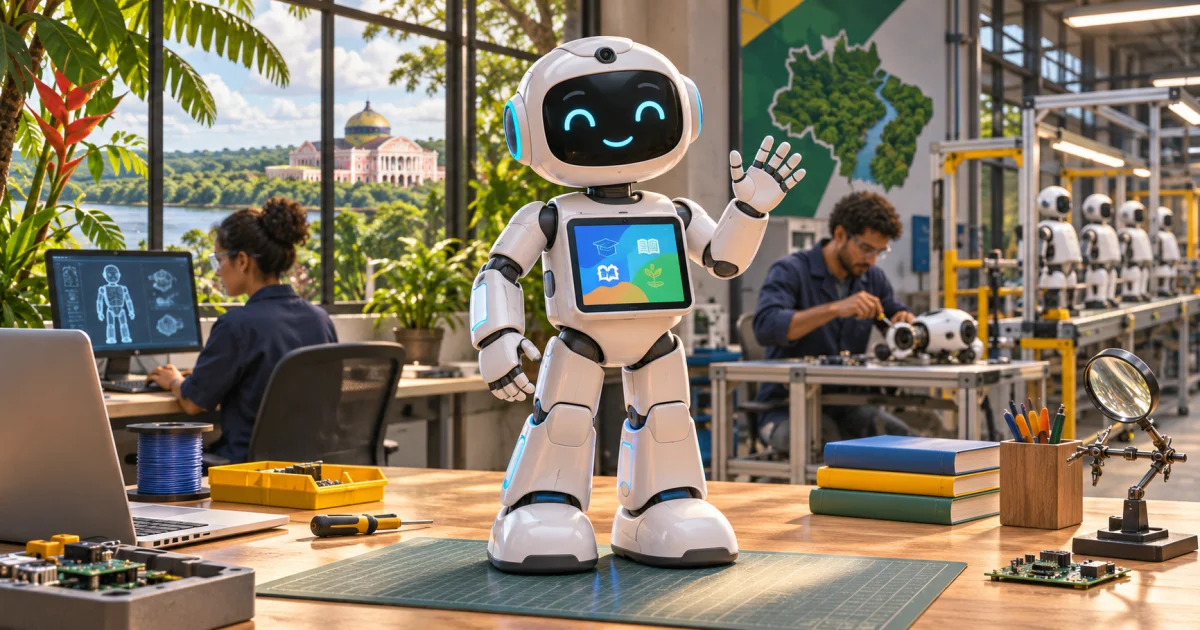
Brazil may gain a humanoid robot factory in 2027, initially focused on education. Amazon-based AMZ AI Robotics, part of Grupo Realms, announced plans to invest US$2.5 million in Manaus. The distinction matters: this is an announced industrial project, not an operating factory.
Confirmed milestones and projections
According to Exame (November 19, 2026), the company has secured premises but still awaits municipal authorization for adaptations. Opening is targeted for June 2027, with 50 initial deliveries in July. Production targets of 200 robots in 2027 and 1,000 in 2028 remain projections.
On November 6, the State University of Amazonas (UEA) documented the public presentation of the AMZ S1 prototype, called EduBot. The university also confirmed a technical cooperation agreement signed in October and plans for the Avançus Laboratory to research humanoid and quadruped robotics and artificial intelligence.
What the AMZ S1 promises
The announced educational robot is 95 cm tall, weighs 19.5 kg and has 22 degrees of freedom. Its planned hardware includes a depth camera, inertial sensor, audio, Wi-Fi 6, Bluetooth, Ethernet, and a Linux computer with Nvidia processing. Two removable batteries are expected to provide approximately 80 minutes each.
Proposed activities include block-based programming, Python, ROS 2, English conversation and reading practice. The company plans to run language models with up to seven billion parameters on the device, alongside cloud services. These are product plans, not independently verified commercial performance results.
Inclusion requires evidence and safeguards
A feature under development displays pictograms on the robot's tablet to support augmentative and alternative communication for autistic students who benefit from it. Autistas Brasil is reportedly participating in validation, with specialist consulting from ConsulTEA.
The promise must not be mistaken for demonstrated educational or therapeutic effectiveness. Schools should evaluate accessibility, teacher involvement, child privacy, informed authorization, and safeguards for cameras, microphones and student records. Assistive technology should complement human support.
What does Brazilian manufacturing mean?
The Manaus operation is expected to integrate components, install software, calibrate and test devices. Motors and other mechatronic parts may come from Chinese suppliers, while the tablet and some exterior parts are planned for local production or sourcing. Integration and software engineering can still create valuable domestic expertise. The meaningful long-term question is how much research, intellectual property and skilled employment remains in Brazil.
Opportunities for developers
Humanoid robotics brings together computer vision, motion control, embedded Linux, AI, networks, cybersecurity and data engineering. Python and ROS 2 offer practical entry points. Engineering questions include offline operation, latency, safe software updates, sensor data governance and reliability.
Economics and what comes next
The estimated unit price is R$78,000, subject to exchange rates. Subscription and service plans are being considered. The founder estimates that approximately 400 annual units would be needed for operating break-even. These figures are business projections, not realized sales.
For schools, procurement should assess teacher training, maintenance, accessibility, safety, support and evidence of learning outcomes. The most important question is not whether robots will replace people, but what useful knowledge and solutions Brazil can build through this technology.