A Little More BADERNA, Please
Meet Marietta Baderna, the Italian ballerina whose surname is traditionally linked to the Brazilian Portuguese word for disorder. Her story deserves a little more attention.
Voices depend on your browser and device; some require internet access. Code blocks are not read aloud.
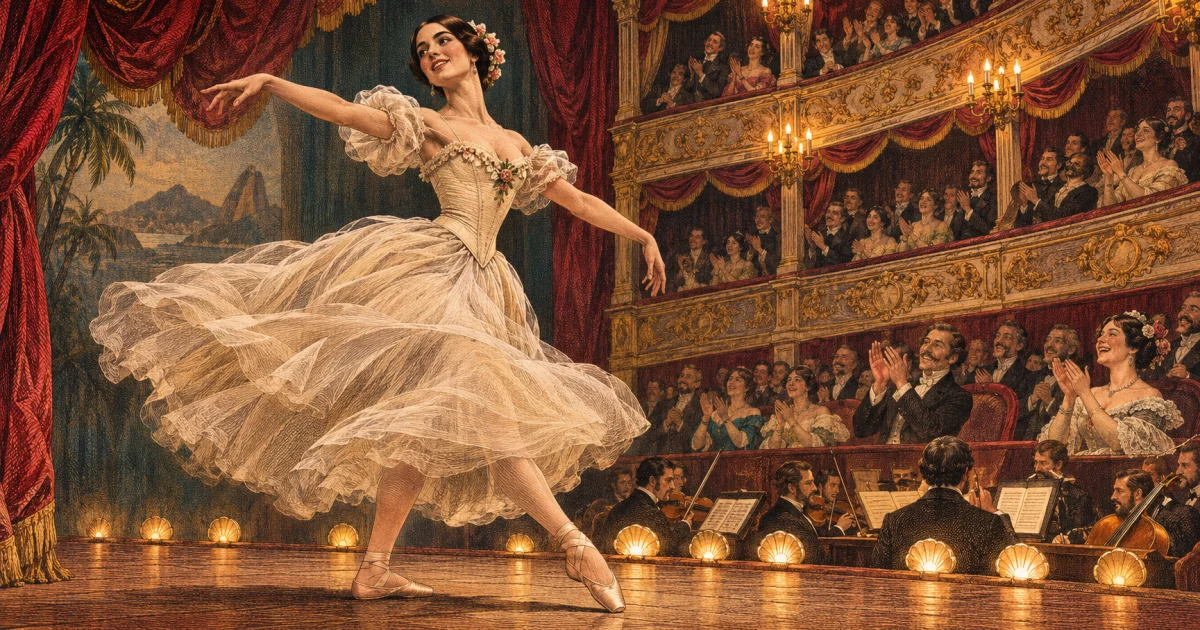
“Pare de fazer baderna!” — Brazilian Portuguese for “Stop causing a commotion!”
The phrase usually brings a conversation to a close. But it could be the beginning of a story: the Brazilian Portuguese meaning of baderna, associated with mess and commotion, is traditionally traced to the surname of an Italian ballerina. Her name was Marietta Baderna, also known as Maria Baderna. 1
Yes: somewhere between the theater and the dictionary, an artist found her way into the vocabulary of people telling others to be quiet. Language has its little ironies.
A ballerina who crossed the Atlantic
Marietta arrived in Brazil in 1849, already experienced on major European stages. On September 29 of that year, she made her debut at the Teatro São Pedro de Alcântara in Rio de Janeiro, performing in the ballet O lago das fadas. Her performance earned praise in the press. 2
Her career in Brazil included seasons in Recife and, later, teaching dance. Among the episodes examined by researchers Maria de Lourdes Rabetti and Adriana Schneider Alcure are announcements of her participation in Lundu d’Amarroá in 1851 at the Teatro Santa Isabel. The program advertised a trio in the farce O recrutamento n’aldeia. 3
It is a cultural encounter worth a closer look: a ballerina trained in the European tradition taking part in a repertoire connected to lundu, a cultural expression with African roots that was already circulating in Brazil. The research shows that this dance appeared on stages and in salons before Baderna’s time in Recife. Her story is part of that movement of artists, rhythms, and ways of dancing. 3
Her achievements, then, include an international career, a role in Brazilian theatrical life, and passing on her knowledge as a teacher. That intriguing surname is a way into the story of an artist with a body of work and a repertoire of her own.
How did a surname come to mean a commotion?
This is where another character enters the story: the audience.
Nineteenth-century theaters had groups of passionate supporters of particular performers, known as partidos teatrais, or theatrical factions. There was applause, rivalry, shouting, and protest. Marietta’s admirers were known as badernistas. In an interview with Jornal da Unicamp, researcher Andrea Carvalho Stark connects the meaning of commotion to these followers’ noisy demonstrations in support of their favorite. 4
Think of an organized supporters’ group, but for theater — our comparison, of course. The audience wanted a part in the show, too.
The connection between the ballerina’s surname and the Brazilian Portuguese word also appears in a study by linguists published by the Accademia della Crusca, an institution devoted to the Italian language. The text links the term to the noisy reactions her performances prompted. 1
That is the traditional explanation for the origin of baderna in the sense of disorder. The Brazilian Portuguese expression “fazer baderna” uses the word with that meaning. This origin should be distinguished from attempts to identify a single night or a particular episode as the exact moment it all began.
The journey from a proper name to a popular expression can hold more nuance than a piece of social media trivia has room for.
A little more of this Baderna
What interests me about this story is how we use a word every day while losing sight of the person behind it.
Rediscovering Marietta means making room for the artist again: her training, her work on stage, her teaching, and the cultural encounters she took part in. It is also an opportunity to look at lundu’s African roots and the collective history within any repertoire.
That is the invitation behind the title. We could be more curious about what seems unfamiliar to us, more willing to explore other influences, and more careful before reducing an artistic expression to a label.
The next time you hear “isso é uma baderna” — “this is a commotion” — perhaps you will remember a ballerina, a noisy audience, and a story that crossed an ocean to remain part of Brazilian Portuguese.
A little more BADERNA, please. This time with a name, a history, and the recognition she deserves.