AI in Rio de Janeiro's healthcare: from WhatsApp messages to diagnostic support
A meeting on healthcare innovation in Rio de Janeiro connects Serena, Rio Farmes, rare diseases and oncology with the challenges of data, care and municipal modernization.
Voices depend on your browser and device; some require internet access. Code blocks are not read aloud.
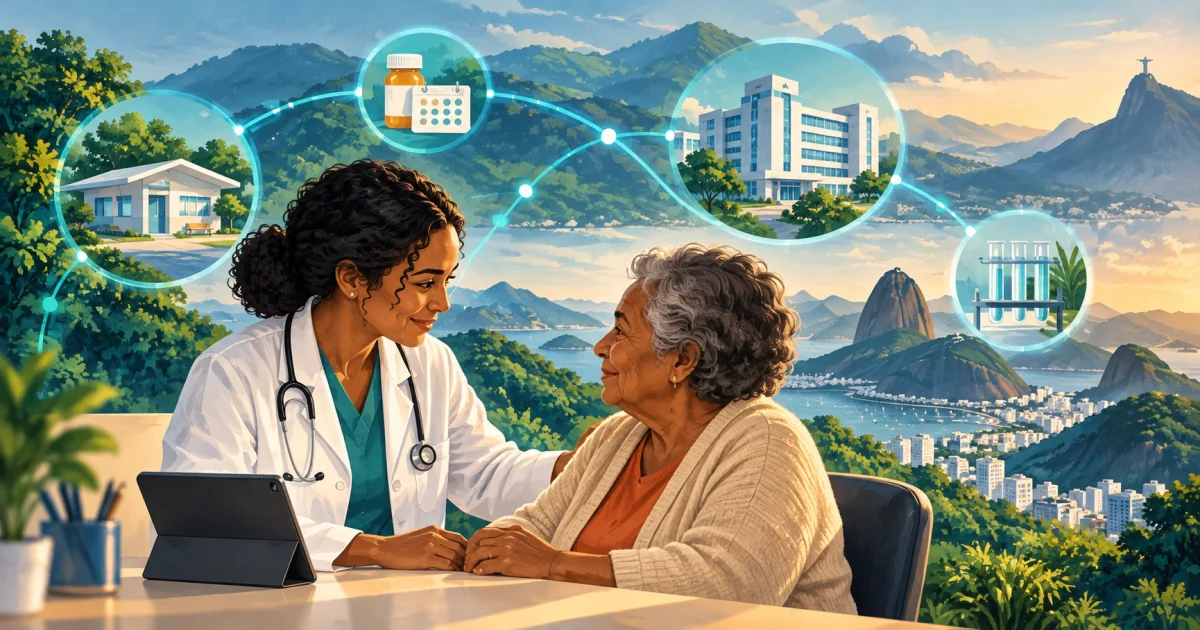
On October 22, 2026, I took part in a meeting with professionals involved in healthcare innovation in Rio de Janeiro. The theme was “The use of Artificial Intelligence to support decision-making and care at SES/RJ,” presented by Leonardo Ferreira, from the Rio de Janeiro State Health Department.
The topics included appointment referrals, access to medicines, rare disease investigation, oncology, data protection, and training. Together, they offer a very practical perspective on artificial intelligence: what changes in the life of someone who needs care?
Think of someone who can find out the date of an appointment without making a string of phone calls. A family that avoids a trip because it received information about a medicine. Or a professional who finds a patient's history well organized and can give more attention to the conversation.
That is where this discussion becomes interesting to me. In modernizing municipal administration, technology makes sense when it improves the experience of the people using a service and those working to provide it.
I brought together the main points from the meeting and looked for public documentation and related research. There are services already operating, initiatives being evaluated, and possibilities for municipalities. Each of these stages deserves to be described clearly.
A message that arrives at the right time is innovation, too
Serena, the virtual assistant for the State Referral Management System, was one of the examples presented. In the slides, it appears integrated into communication, referral tracking, information analysis, and task automation.
In practice, part of this work is already publicly documented: in August 2026, the Rio de Janeiro State Health Department (SES-RJ) announced that patients could confirm attendance or request that appointments be postponed through WhatsApp. It also reported that more than 1.5 million notifications had been sent. Source: SES-RJ, August 26, 2026.
A report released in May pointed to a reduction in the missed-appointment rate from 43% in 2025 to 32%. That is 11 percentage points. The department associates the improvement with a set of measures, including Serena and campaigns to update patient contact details. The report does not isolate the effect of AI. Source: SES-RJ, May 29, 2026.
That distinction helps us understand the project. A notification needs to reach the right number, make sense to the recipient, and offer a way to act. A message sent to an old phone number brings no one closer to care, however sophisticated the system behind it may be.
It is also worth looking at why people miss appointments. Forgetfulness, incomplete information, transportation difficulties, and scheduling conflicts call for different responses. A communication channel can help identify the problem and allow the team to step in.
For municipal administration, this is a useful starting point: follow the entire journey, from the initial request to the care actually provided. The measure that matters is whether people received the care they needed.
Rio Farmes: useful information before leaving home
Another example was the digital service offered by Rio Farmes. The presentation showed a journey covering registration, tracking document reviews, scheduling, reminders, and questions about medicines.
SES-RJ announced the WhatsApp channel in July 2026 for the Praça XI, Duque de Caxias, and Nova Iguaçu locations, which served 60,000 users. The service provides information about registration, collection, and medicine availability; telephone support remained available. Source: SES-RJ, July 6, 2026.
Imagine the value of receiving clear guidance before spending time and money on a trip. For someone who relies on transportation, needs a companion, or organizes the day around treatment, that information can make a considerable difference.
A project like this needs to consider what happens when the automated conversation does not resolve the issue. Who takes over? How is an outstanding requirement explained? Can the person understand which document needs to be corrected? Is there an alternative for someone who cannot use the digital channel?
These are service design questions. The quality of the answer depends as much on how the service is organized as on the technology chosen.
The foundations are data and teams
One slide organized the department's preparation into four areas: infrastructure, governance, data, and training. Another highlighted the integration of referral management, surveillance, and information for healthcare management.
This work has a history that predates the projects presented. Inaugurated in July 2023, Rio de Janeiro's Health Intelligence Center brings together referral management, epidemiological surveillance, and information management, with support from the Pan American Health Organization (PAHO) in its development. Source: SES-RJ.
One word that comes up frequently in this discussion deserves an explanation: interoperability. It is the ability of different systems to exchange information in an understandable and secure way. For patients, the expectation is simple: the next service should be able to use what the previous one has already recorded, within the applicable access rules.
Integration requires agreement on identification, format, quality, updates, and responsibility for the data. If two databases describe the same person in incompatible ways, artificial intelligence may receive an incomplete or mixed-up history.
Not every integration or automation uses AI. Organizing a registry, eliminating duplicate data entry, and making information available at the right time can already improve a service. The choice of technique should follow the problem we want to solve.
There is a recent national connection: in September 2026, Brazil's Ministry of Health announced the completion of the state-level phase of the federalization of the National Health Data Network, or RNDS, involving all 27 federative units, and preparations to extend the process to municipalities. This does not mean that every municipality is already fully integrated. Source: Ministry of Health, September 21, 2026.
For those working in municipal government, the practical message is to start organizing these foundations now: know the systems, understand the workflows, and prepare the people who will use the information.
Rare diseases: helping bring the clues together
Orion Raras, from Fenix, was presented as a tool to support rare disease investigation. The proposal brings together a patient's history, organizes information from appointments, tests, and medicines, and flags hypotheses with explanations and references for professional assessment.
In the meeting materials, the pilot was associated with Hospital Universitário Pedro Ernesto, involving Internal Medicine, Genetics, and Neurology. A 30% reduction in time to diagnosis appeared as an expected outcome of a 12-month pilot. This is a stated target, which still needs to be assessed against the results of the follow-up.
There is public confirmation of a contract for testing: the published extract of Contract No. 051/2026, with Fenix, identifies the rare disease challenge and provides for an initial 12-month term. Source: Rio de Janeiro Official Gazette, May 29, 2026, final page of this document.
The potential of this approach lies in helping connect information that may be difficult to interpret in isolation. Even so, its usefulness depends on specialists being able to verify what supports each suggestion, identify errors in the history, and decide whether a hypothesis makes sense for the person receiving care.
To evaluate a pilot like this, I would want to track the time to an appropriate diagnostic workup, the proportion of useful alerts, unnecessary referrals, and families' experiences. An isolated accuracy percentage needs to come with an explanation of how it was calculated and what counted as a correct result.
This is a discussion that brings technology closer to care: making the job easier for those who need to piece the clues together, with clinical responsibility and the ability to review the findings.
Huna: what a routine test can add to an investigation
Huna appeared with a proposal to analyze information from blood tests that have already been performed, helping identify risk profiles in oncology. The presentation indicated testing with Rio Imagem Baixada and Hospital Mário Kroeff, along with a prospect of expansion. These stages were described at the meeting, and expansion should be treated as a plan.
There is related scientific research. A retrospective study published in Scientific Reports in 2024 analyzed data from 396,848 women aged 40 to 70 for breast cancer risk stratification. The model reported an AUC of 0.64, a measure of discrimination that does not mean “64% of diagnoses were correct.” Source: Araujo and colleagues.
In a report on a Huna project supported by the PIPE program, FAPESP describes its complementary purpose: helping prioritize further investigation while preserving the role of tests such as mammography and ultrasound. Source: Research for Innovation FAPESP, May 28, 2024.
It is an interesting possibility precisely because it seeks to draw useful information from available data. To become part of everyday care, it needs to be evaluated in the population served, within the referral workflow, and against the capacity to respond to the alerts it generates.
We also need to distinguish between reusing test results and implementation costs. Contract No. 044/2026 between SES-RJ and Huna provides for paid testing. Reusing an existing complete blood count, therefore, does not make the entire solution free. Source: SES-RJ contract.
My view is that the benefit needs to show up in the patient's journey. Identifying a risk only becomes beneficial when there is a team ready to assess the result and a viable path for continuing the investigation.
Innovation in the public sector also requires knowing how to test
The meeting presented four areas linked to the procurement of innovative solutions: Huna, in oncology; Tismoo, in care related to autism spectrum disorder; Fenix, in rare diseases; and Crisálida, in pharmaceutical services.
SES-RJ's CPSI Call for Proposals No. 001/2025 set out challenges for testing. CPSI, the Portuguese acronym for Public Contract for an Innovative Solution, is an instrument established under Brazil's Legal Framework for Startups, Complementary Law No. 182/2021, allowing public bodies to contract for the testing of solutions. Sources: SES-RJ call for proposals and Complementary Law No. 182/2021.
For public administration, this creates an important task before expansion: define the problem, the baseline, and the criteria for deciding whether a test worked.
A demonstration may show that a system responds. An evaluation needs to show whether its response is useful, whether it fits teams' routines, and whether the benefit justifies the cost. It should also make it possible to recognize when a hypothesis has not been confirmed.
I see value in that discipline. Testing with clear objectives helps turn a good idea into a public decision that can be explained and monitored.
Trust, rules, and human care
The meeting also presented a 2024 Medscape survey of 1,279 doctors. In the charts shown, 79% had a positive perception of AI's impact on maintaining and administering medical records, compared with 31% for communication with patients. These are survey participants' opinions, not measures of clinical effectiveness. Survey cited in the presentation.
That difference helps frame a question: in which tasks does technology free up time, and where might it affect a relationship that requires listening, context, and sensitivity?
The presentation also raised the shift from “Dr. Google” to conversational assistants. A fluent response can sound convincing. For someone managing a healthcare service, however, it is necessary to know who checks the content, what the tool's limits are, and how a person reaches a professional when needed.
Federal Council of Medicine (CFM) Resolution No. 2.454/2026, in force since August 26, establishes rules for the use of AI in medicine. It keeps clinical decisions with the physician, requires the use of AI for decision support to be recorded, and prohibits delegating the communication of diagnoses, prognoses, or treatment decisions without human mediation. Sources: resolution and CFM announcement.
In healthcare, I hope that time saved on repetitive tasks helps create room for better questions, clearer explanations, and follow-up. That expectation should guide how projects are designed and evaluated.
Data protection is part of delivering the service
For those who work with systems, this deserves attention from the outset. Brazil's General Data Protection Law (LGPD) classifies personal data concerning health as sensitive personal data and establishes specific lawful grounds for processing it. It also requires security measures from the service's design stage. The purpose and legal basis need to be appropriate for each processing operation. Source: LGPD, Articles 5, 11, and 46.
This needs to be reflected in project decisions: who can access a patient's history, what information is sent to the supplier, how access is logged, how long data is retained, and how the team responds to an incident.
An AI suggestion should also be open to verification. The professional needs to be able to distinguish what came from the medical record, what was inferred by the system, and what is still missing. The same concern applies to summaries: something important cannot disappear simply because the text became shorter.
At the state level, Decree No. 50.523, of October 13, 2026, established the Rio de Janeiro State Artificial Intelligence Policy, known as PIAF. Its guidelines apply to the state executive branch, and it provides for data protection by design and by default. Municipalities' participation in the ecosystem does not automatically turn every provision into a municipal obligation. Source: decree published in the Rio de Janeiro Official Gazette on October 14, 2026.
The institutional preparation presented at the meeting makes sense in this context: understandable rules, defined responsibilities, and teams that know how to use the tool and recognize its limits.
What I take from this discussion into municipal practice
Thinking about Pinheiral and other municipalities, I see an agenda that can be built in stages. The experiences presented help us formulate questions about our own services, respecting each administration's needs, capacity, and decisions.
I would start with five points:
- Choose a specific difficulty faced by residents. Confusing guidance, an unresolved issue with no follow-up, or an avoidable trip are problems that can be described and measured.
- Understand the care journey. Identify where information originates, which teams it passes through, and when it stops reaching those who need it.
- Prepare the data and the people. Registration records, integration, access rules, and training need to develop alongside implementation.
- Test against a defined outcome. Measure completed appointments, response times, rework, or another indicator linked to the problem chosen.
- Maintain welcoming support and alternative ways to access services. The solution also needs to work for those who struggle with digital channels or need human assistance.
This approach makes it possible to use innovation with criteria that residents can recognize. Receiving useful information, understanding the next step, and finding a team equipped to help are very concrete outcomes.
The question for future projects is simple: after the technology was introduced, did care improve for the people who needed it?
That is the answer I want to keep following.
This article was prepared from records of the October 22, 2026 meeting and the public sources linked throughout the text. Pilot locations and targets are attributed to the presentation where there is no specific public confirmation. The observations about municipalities are the author's reflections and do not announce adoption or implementation in Pinheiral.