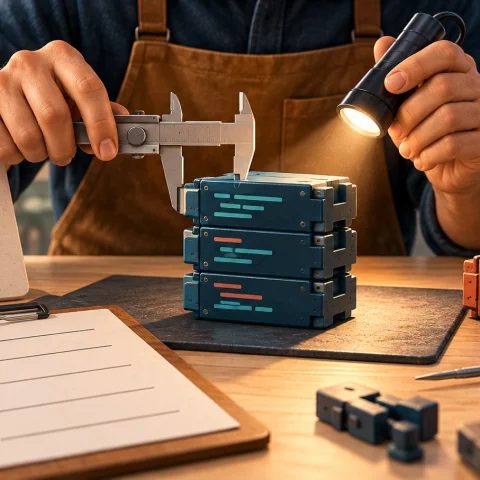
VisionQuest: Vision, His AI Agents, and the Reality of 2026
Watching VisionQuest, I see parallels with the AI agents we can build in 2026: specialists working together, different personalities, a race for greater capability, and the question of who gets the administrator password.
Voices depend on your browser and device; some require internet access. Code blocks are not read aloud.
Spoiler warning: these are my impressions while I'm on the fourth episode of VisionQuest. I only discuss what I've seen so far. Any suspicions about where the story is heading are my own theories.
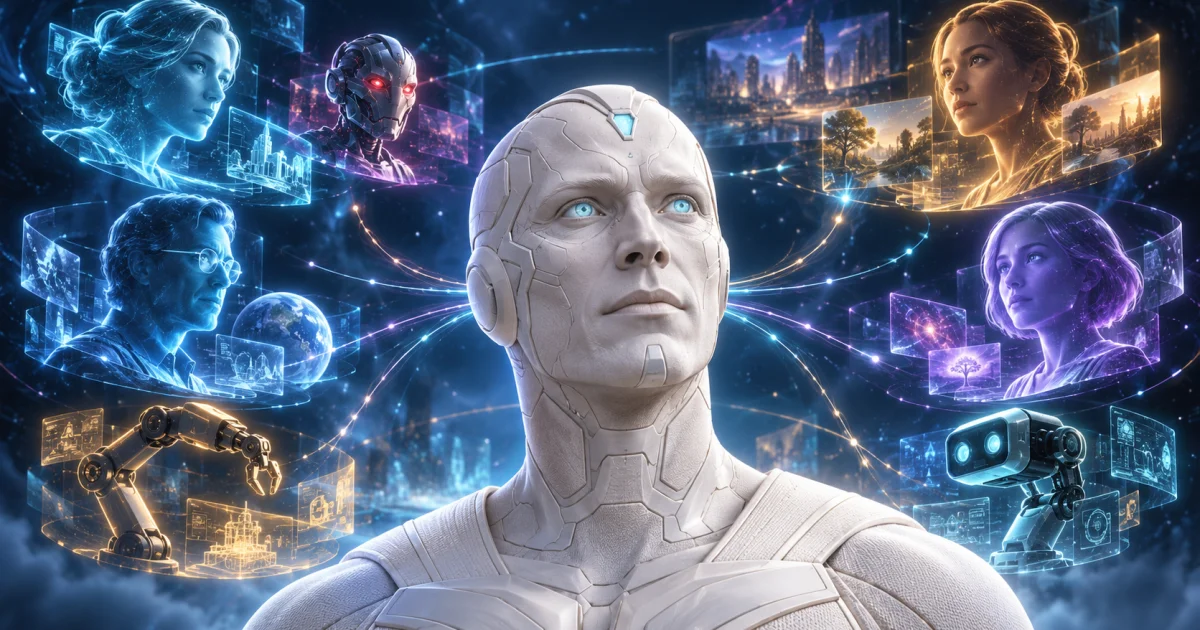
I'm watching VisionQuest, and one thing has caught my attention as much as the story itself: Vision is carrying an entire team of artificial intelligences inside him.
There's F.R.I.D.A.Y., E.D.I.T.H., DUM-E, U, and, just to make every meeting a little more relaxing, Ultron himself. Each has their own style, priorities, and way of interpreting a situation. Vision talks to them, looks for explanations, considers possibilities, and tries to figure out what to do.
At one point, I caught myself thinking: this looks like a computer with several AI agents working together. In technology, that arrangement is usually called a multi-agent system. Except, in this case, the computer walks, talks, and has considerably bigger problems than a Windows update.
The official Disney+ description presents these figures as AI personas integrated into Vision's programming and includes J.A.R.V.I.S. among them. The robots DUM-E and U are part of that mental landscape, too.
Of course, Marvel throws consciousness, feelings, and existential crises into the package. But looking at what we can build with AI in 2026, the distance between that idea and our everyday work has become pretty interesting.
Vision has the whole team in his head
Imagine asking a system: “I want to understand why my store's sales have dropped.”
One agent could investigate inventory. Another could examine prices and margins. A third would analyze the ads. Another would look into customer complaints. In the end, a coordinator would bring the findings together to produce a useful answer.
Maybe the ad is great, but the most popular product is out of stock. Maybe the price is competitive, but delivery times are putting buyers off. Without connecting that information, someone might suggest spending more on advertising a product you don't even have available to ship.
That's how I see some of Vision's conversations: he consults different perspectives to understand a bigger problem.
There are already concrete examples of this way of organizing work. Anthropic described a research system in which a lead agent plans the task, delegates investigations to other agents, and brings the results together.
In my analogy, Vision takes on that coordinating role. It's a way to explain the idea without requiring anyone to know how to code. The series turns into characters what, in a real system, might appear as tasks, messages, and tool calls.
Each agent has a job. And it can have a style
In the series, the different personalities make the interactions fun. In practice, we can also configure agents with different styles and priorities.
Imagine a team developing a piece of software. One agent is tasked with implementing a feature. Another examines potential security issues. A third checks whether the result meets the request. They're all looking at the same work, but asking different questions.
The first might say: “The feature is ready.” The second replies: “Great. Now let's talk about that administrator access.” And the third asks: “Did you test what happens when the user leaves the field blank?”
Those lines are made-up examples, but the dynamic is easy to recognize. If you develop software, you've probably been in that meeting. Sometimes alone, switching between all three chairs.
Specialization can come from the instructions, the available data, and the tools each agent is allowed to use. We don't even need to imagine a completely different model behind every character: the same model can support agents with distinct roles. And a system we access from our computer can distribute that work across cloud services.
We do need to be careful with one tempting leap: a convincing conversational style does not, by itself, demonstrate consciousness. A patient agent can produce reassuring replies; a reviewer can sound skeptical. That doesn't establish that they feel patience or skepticism the way a person does. An Anthropic research hypothesis about AI personas helps us discuss that distinction, without settling every question about what happens inside these models.
In VisionQuest, fiction can freely explore that inner life. In our work, it makes sense to assess behavior, results, and access limits.
The new robot and the race for the most powerful AI
In the fourth episode, another intelligent robot appears and, as far as I've seen, seems to pose a new threat to Vision. That led me to another comparison: the competition between companies to bring a more capable AI to market.
It feels a bit like following technology launches: you start to understand a tool, organize your work around it, and another one soon arrives promising to do more, with greater autonomy and less effort.
To bring that comparison into a practical setting, imagine an assistant that answers questions for a store. A competitor arrives that can look up orders, check stock, and prepare a solution. Then another can coordinate several of those tasks. The competition starts to revolve around how much a system can accomplish with the access it has been given.
But “more powerful” needs context. For customer service, getting answers right and respecting company rules may matter more. For a developer, understanding an existing project could be more valuable. For a small operation, price, speed, and predictability might decide the choice.
An impressive robot makes a great on-screen threat. An agent that completes a simple task without making things up can be a huge achievement for a business.
And Ultron? I'm still suspicious
At this point in the series, my feeling is that Ultron could still turn out to be the main villain. The possibility of him taking over that other robot's body has even crossed my mind.
That's my own theory. It hasn't happened in the part I've watched, and I'm not revealing any future outcome. It's the kind of suspicion you get when a character with that history looks a little too comfortable near the controls.
But that hypothesis also makes for an interesting analogy. In real systems, an AI's reach depends on the tools and permissions connected to it.
An assistant that only suggests a reply has one level of reach. One that can send messages, change prices, or execute code has another. In this comparison, the “body” represents the means to act on the world.
Think of a customer service agent that can look up orders and prepare replies. Now imagine it gains access to grant unlimited discounts and change customer records. Even without changing the model, you've substantially changed the scale of a potential mistake.
There's also the risk of someone trying to redirect that agent through the content it reads. Prompt injection attacks place malicious instructions in pages, messages, or documents to try to make an agent act outside its assigned task.
The metaphor of “stealing a body” can help us picture an attempt to use another system's access. There is a limit to that comparison: a malicious instruction doesn't need consciousness, a will of its own, or a villain's monologue to cause trouble.
That's why, when designing something like this, I'd give each agent the access its role requires, keep a record of its actions, and reserve higher-impact decisions for appropriate approval. The copy editor doesn't need the keys to the entire building.
Several AIs together can also make quite a mess
A team of agents needs organization. If the sales agent promises a delivery date without checking with logistics, all that intelligence ends with an annoyed customer. If two agents change the same part of a system without coordinating, they can get in each other's way.
The technical experience Anthropic reported also highlights costs and coordination challenges. Dividing tasks requires defining responsibilities and bringing results together; adding more agents to the process doesn't guarantee a better solution.
I also wouldn't treat five agreeing answers as proof that they're right. If everyone received the same bad data, the meeting could end with an excellent presentation of a terrible conclusion.
Sometimes, one well-directed agent does the job. In other situations, distributing the work is worthwhile. That choice depends on the task, the cost, and how easily you can check the result.
Let's face it: if a meeting with five people can lose its way, the digital version isn't going to become organized by magic.
In 2026, the analogy already fits our daily work
What interests me most about VisionQuest is the chance to look at Vision and recognize technology problems: different specialists, conflicting opinions, misunderstood objectives, competition over capability, and questions about who should have access to what.
The series dramatizes all of this through characters with their own histories, personalities, and conflicts. In real life, we can use the comparison to think more carefully about the systems we're building and the decisions we're handing over to them.
I'll keep watching to find out what Marvel does with this group. As a developer, I also keep wondering how many of those conversations could translate into far less cinematic situations: reviewing code, investigating falling sales, or handling a difficult customer service case.
And for now, I'm sticking to my position on Ultron: he can join the conversation. I'd keep the administrator password to myself.
Update after finishing episode four — spoilers
Well, there it is: I hadn't finished the episode when I wrote this article. At the end, Vision hands control of his own body over to Ultron. My theory about Ultron taking over the other robot's body remains just a theory, but the analogy with AI agents has become even more direct: the agent who was part of the conversation is given permission to act.
I ended by saying I'd keep the administrator password to myself. Vision decided to share his.