What if knowledge were the currency? My undergraduate thesis, INTYME and CONIC
INTYME grew out of the proposal for my undergraduate thesis on the solidarity economy and learning among university students. I look back at the research, Luciana Sessa’s guidance and my trip to São Paulo to present the project at CONIC-SEMESP in 2018.
Voices depend on your browser and device; some require internet access. Code blocks are not read aloud.
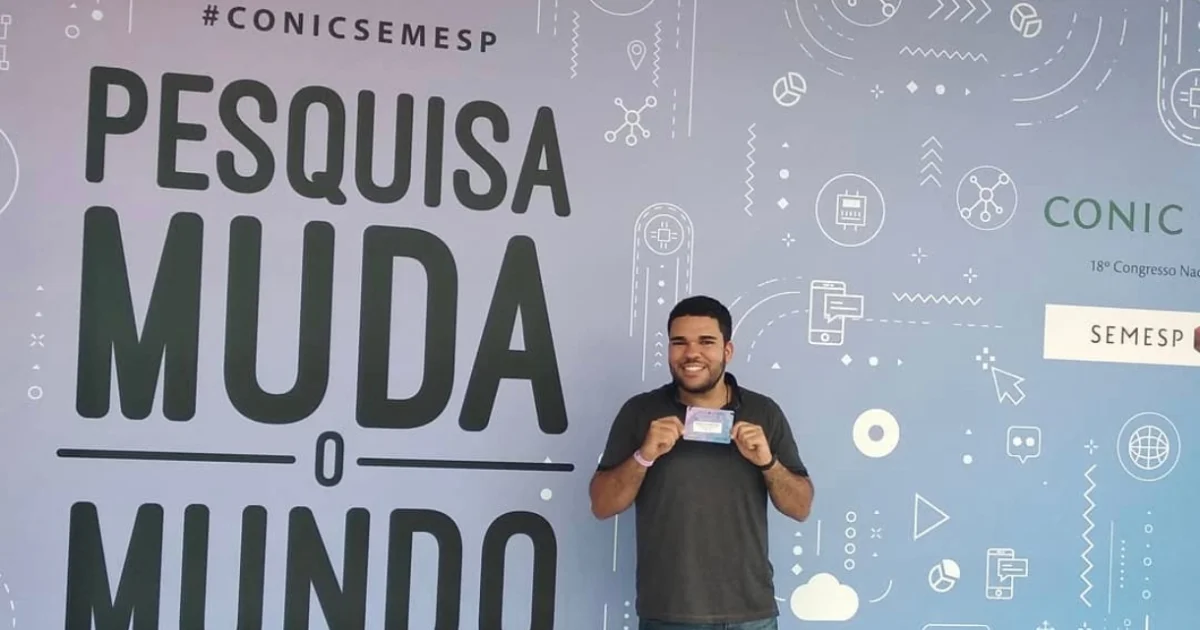
In the photo accompanying this article, I’m in São Paulo at CONIC-SEMESP in 2018, holding my badge in front of a backdrop that reads “Research changes the world.”
I had traveled there to present INTYME, a project that grew out of the proposal for my final-year research project in Business Administration, known in Brazil as a Trabalho de Conclusão de Curso, or TCC. Behind that name was a question familiar to almost any university student: what if the knowledge a student already has could help them access the knowledge they need?
You understand one subject. Your classmate understands another. You both need help, both have something to offer, and can’t always afford private tutoring or find a time that works for both of you. How could technology make that connection easier?
That relationship between people, learning and systems was what I set out to investigate. It still strikes me as an excellent starting point for talking about software development that serves a real purpose.
The question behind my thesis and INTYME
My undergraduate thesis was titled “The principle of the solidarity economy as a tool for the development of undergraduate students” (O princípio da economia solidária como ferramenta para o desenvolvimento dos acadêmicos de graduação). I wrote it in 2018 as part of my Business Administration degree at Centro Universitário Geraldo Di Biase, or UGB, in Volta Redonda, under the supervision of Professor Luciana Sessa Generoso de França.
INTYME grew out of the proposal for that thesis. The two papers were written concurrently, with Luciana guiding both my final-year research and the undergraduate research project.
While the thesis investigated the challenges and possibilities of exchanging knowledge among students, INTYME gave shape to a proposal for applying that idea through information technology.
That connection helps explain what I was trying to do: understand a need and use it as the starting point for a solution. The system’s development had a human question to answer.
A 27-minute video lesson made the question tangible
One of the experiences analyzed in my thesis took place in June 2017.
A classmate had missed lessons and an assessment in our Entrepreneurship course. She needed to understand Cost Composition Calculations, but was having trouble finding material that matched what we were studying.
I recorded a 27-minute video lesson and made it available on YouTube on June 17, 2017. I produced the material when I had time; she watched it that evening, when she could.
It was a simple tool with a clear practical effect: our schedules no longer had to match. She could also pause, rewind and watch the explanation again.
In the case described in my thesis, my classmate reported that she understood the material better, and the paper records a good result in her assessment. That experience became part of the study’s qualitative analysis.
It was an individual experience of collaboration between classmates, analyzed in my thesis. It helped reveal a possibility; measuring its effects on an entire class’s performance would require a broader study.
Even so, there was something useful happening: one student’s knowledge could reach another at the moment they were able to study.
Students were already helping each other. Connecting them was the challenge
The opinion survey in my thesis involved 91 Business Administration students in their third through fifth semesters at UGB in Volta Redonda. It consisted of five closed-ended questions, combined with a literature review and the interview about the video lesson.
Several findings help explain the proposal:
| What the students reported | Result |
|---|---|
| Had other activities beyond their academic responsibilities | 88% |
| Turned to classmates to clarify questions or catch up on course material | 76% |
| Identified their own availability as the main difficulty in studying with classmates | 55% |
| Identified finding someone available to help as the main difficulty | 45% |
| Considered the lack of complete, free materials their main difficulty when searching for learning resources | 55% |
Source: my undergraduate thesis, 2018, printed pages 11–14. The 55%/45% split represents the two alternatives in a single question about availability.
These figures describe the group surveyed. The 88%, for example, includes different activities outside academic responsibilities; it does not mean all those students were employed.
The finding that best helps explain INTYME is the 76% who turned to classmates. Collaboration was already evident in the responses. There was an existing practice that could be better organized.
At the same time, the split between students who lacked time and those who couldn’t find someone available revealed a coordination problem. One person might be able to explain exactly what another needed, but providing that help depended on their finding each other and arranging the exchange.
My interpretation was that there was room to make this knowledge easier to share. The results did not measure willingness to join INTYME or predict how many people would use a platform.
Applying the solidarity economy to learning
The solidarity economy provided the conceptual foundation for thinking about this relationship.
In the thesis’s theoretical framework, it is associated with cooperation, self-management, economic activity and solidarity. These principles involve people participating in decisions, creating shared benefits and recognizing what each member can contribute.
Applied to education, they suggest a community in which students also contribute to other people’s learning. Someone who needs help with one subject may find another easier and take part in the network by sharing that knowledge.
Consider an example: one person helps with costs; another can explain financial mathematics; a third knows how to organize a spreadsheet. Each has a useful skill, even though none knows everything.
The thesis also discussed time banks. In the Portuguese Banco de Tempo, participants record the time they spend helping someone and can receive services from other members. Reciprocity happens across the network, without requiring the same two people to return every favor directly.
That reference helped me think about ways of accessing knowledge without spending money on every exchange. In INTYME, the proposal took shape through its own credits, called tyme.
For me, there is a valuable idea in this approach: someone who arrives needing to learn can also be recognized for what they already know.
INTYME: a proposal to connect those people
In the conference proceedings, the project was registered as “INTYME — Solidarity economy as a strategy for human development through the use of information technology”, in the In progress category. The official CONIC record identifies UGB as its institution.
The project description in Luciana Sessa’s academic CV, reproduced by Escavador, records the development of a website to bring together students from different UGB programs. The proposal combined the solidarity economy, gamification and exchanges mediated by credits called tyme.
A simple way to picture the proposal is to imagine a student offering help with material they understand, then using the credits from that contribution to seek help with something else.
The challenge for such a system goes beyond credit balances. It needs to help people discover who can contribute, explain what they are looking for and arrange a form of participation that makes sense to both sides.
That is where I see the connection between Business Administration and software development: organizing information, incentives and processes so that a need can find a response.
My trip to São Paulo and presentation at CONIC
INTYME was the project I traveled to São Paulo to present at the 18th CONIC-SEMESP, Brazil’s National Undergraduate Research Congress.
The event took place on November 30 and December 1, 2018, at UNIP’s Cidade Universitária campus, according to Semesp’s announcement of that edition.
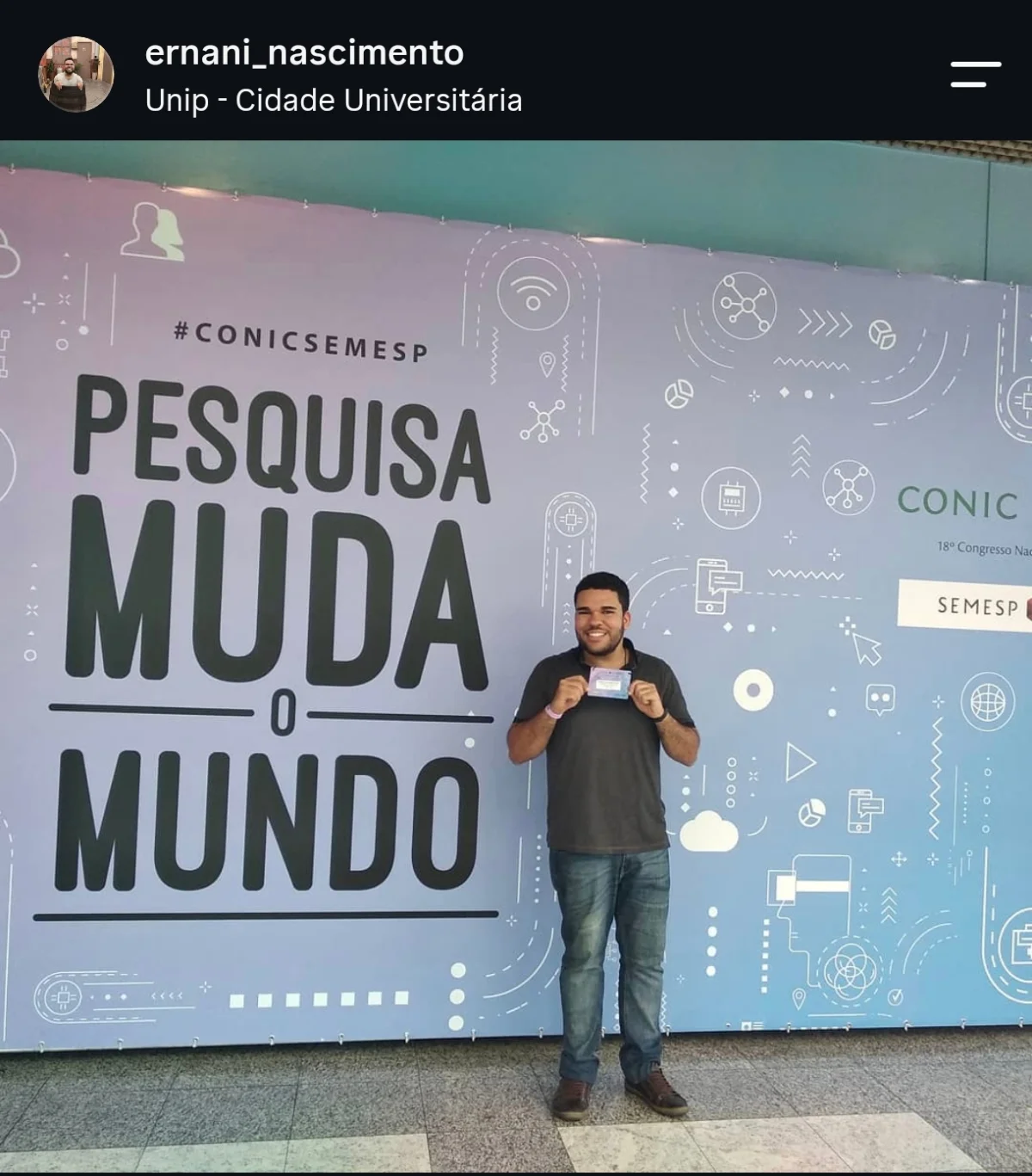
At CONIC-SEMESP in 2018, held at UNIP’s Cidade Universitária campus in São Paulo. Personal collection.
INTYME was also a collective effort. Alongside me, the proceedings list Marcus Vinícius Amaro de Medeiros de Souza, Victor Carvalho da Matta and Mariana Ferreira Costa as authors. Luciana Sessa Generoso and Rafael Teixeira dos Santos are listed as supervisors.
Luciana has a special place in this story because she guided both pieces of work: my thesis and the project presented at the conference. Acknowledging her supervision and the other participants is part of telling the story with proper recognition.
The photo captures the connection between research developed during my degree and its presentation at a national conference. When I revisit it, I see the continuity of a question that still guides my interest in technology: how can a solution help someone in a concrete way?
What I would consider when developing a proposal like this today
Revisiting my thesis also lets me look at the idea through the experience that came afterward. If I were designing a similar initiative today, I would start with a small group and observe the exchanges before expanding the system.
There are several questions I would put at the center of that work.
Finding the right help
Searching for “accounting” can return a lot of things. Someone who needs to resolve a question about cost composition needs something more specific: the topic, difficulty level, course context and format of the help offered.
I would try to organize that information simply. A successful search would bring the student closer to an explanation that addresses the question they came with.
Making it possible to learn and contribute
Someone joining the community needs a way to get started. Requiring a history of contributions before granting any access could create a barrier precisely for newcomers.
Together with the participants, we would need to decide how to welcome new members, recognize contributions and handle missed commitments or exchanges that did not work out. The criteria would need to be understandable to the people using the system.
Cooperation also depends on these small decisions about how things work.
Looking after the quality of the knowledge shared
A classmate can explain something well and still make a mistake. That is why I would include ways to correct materials, provide references and flag questions that need to go back to the teacher.
The thesis treated non-formal education as a complement to university education. Preserving that relationship is essential: exchanges among students can expand opportunities to study while formal education retains its responsibilities.
I would also consider alternatives to video, such as text and audio, to accommodate different needs and access conditions.
Measuring what actually helped
Gamification was part of the INTYME proposal. Revisiting the idea, I would carefully assess what each incentive encourages.
Accumulating points or publishing lots of materials can generate activity on a platform. To understand whether it is meeting its purpose, I would look at whether questions were addressed, explanations were considered useful and participants came back to contribute.
Evaluating effects on learning would require its own research plan. The number of visits alone would not answer that question.
Planning for continuity
Exchanges without payment between participants still need infrastructure. Hosting, maintenance, support and moderation require resources and time.
I would make the initiative’s sustainability part of the project from the outset: who looks after it, how decisions are made and where the resources needed to maintain the service come from. That would help preserve access over time.
An idea that connects with what I do today
Today, working in software development and integrations, including at Oombe, I continue to encounter situations in which information exists but needs to reach the right person, in the right format and at the right time.
In my thesis, that information was knowledge of a subject. In software development, the context changes, but the need remains to understand who will use the solution, what difficulties they face and what they need to be able to do.
That is also one of the reasons I share knowledge here on the blog. An explanation of technology, an experience from a project or an account of a problem solved can be useful to someone facing a similar challenge.
The words “Research changes the world” on the backdrop in that photo take on a very personal meaning when I think about this story. A concrete experience of classmates helping each other found its place in academic research. INTYME brought that discussion of learning and cooperation into a proposal for a system and a presentation at CONIC.
INTYME emerged along that path, alongside the writing of my thesis and with other people’s contributions. Revisiting the experience reminds me that developing a solution starts with paying attention to what someone needs.
And here is a question for anyone who has read this far: what do you know today that could help someone else learn?
Sources and references
- NASCIMENTO FILHO, Ernani. O princípio da economia solidária como ferramenta para o desenvolvimento dos acadêmicos de graduação. Undergraduate thesis in Business Administration. Centro Universitário Geraldo Di Biase, Volta Redonda, 2018. Supervisor: Professor Luciana Sessa Generoso de França. The main source for this article; findings and the experience discussed appear on printed pages 11–16.
- CONIC-SEMESP. Official record of the INTYME project in the 2018 proceedings. Authorship, supervision, institution and project category.
- SEMESP. Semesp hosts Brazil’s largest undergraduate research congress. Published November 23, 2018; event dates and location.
- Luciana Sessa Generoso de França. Academic CV reproduced by Escavador from the Lattes platform. Records of the thesis and the INTYME research project.
- Banco de Tempo. Official website of the Portuguese initiative. The concept and operation of time exchanges.