Cecília and Clínico.ia: the journey from conversation to care
Clínico.ia’s material at fswk.rio raises a product question: how can a personal account be organized without losing context, authorship and professional responsibility?
Voices depend on your browser and device; some require internet access. Code blocks are not read aloud.
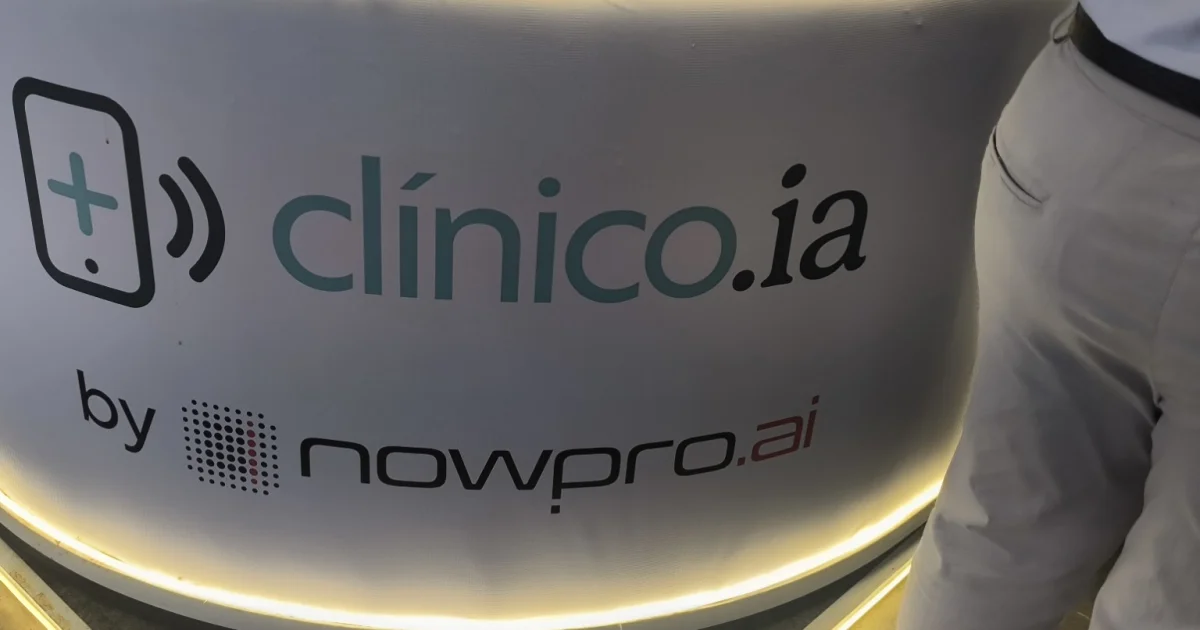
During my visit to fswk.rio on November 13, 2026, I photographed material from Clínico.ia and its assistant, Cecília. The proposal begins with a familiar situation: someone wants to describe how they are feeling and needs a route to care.
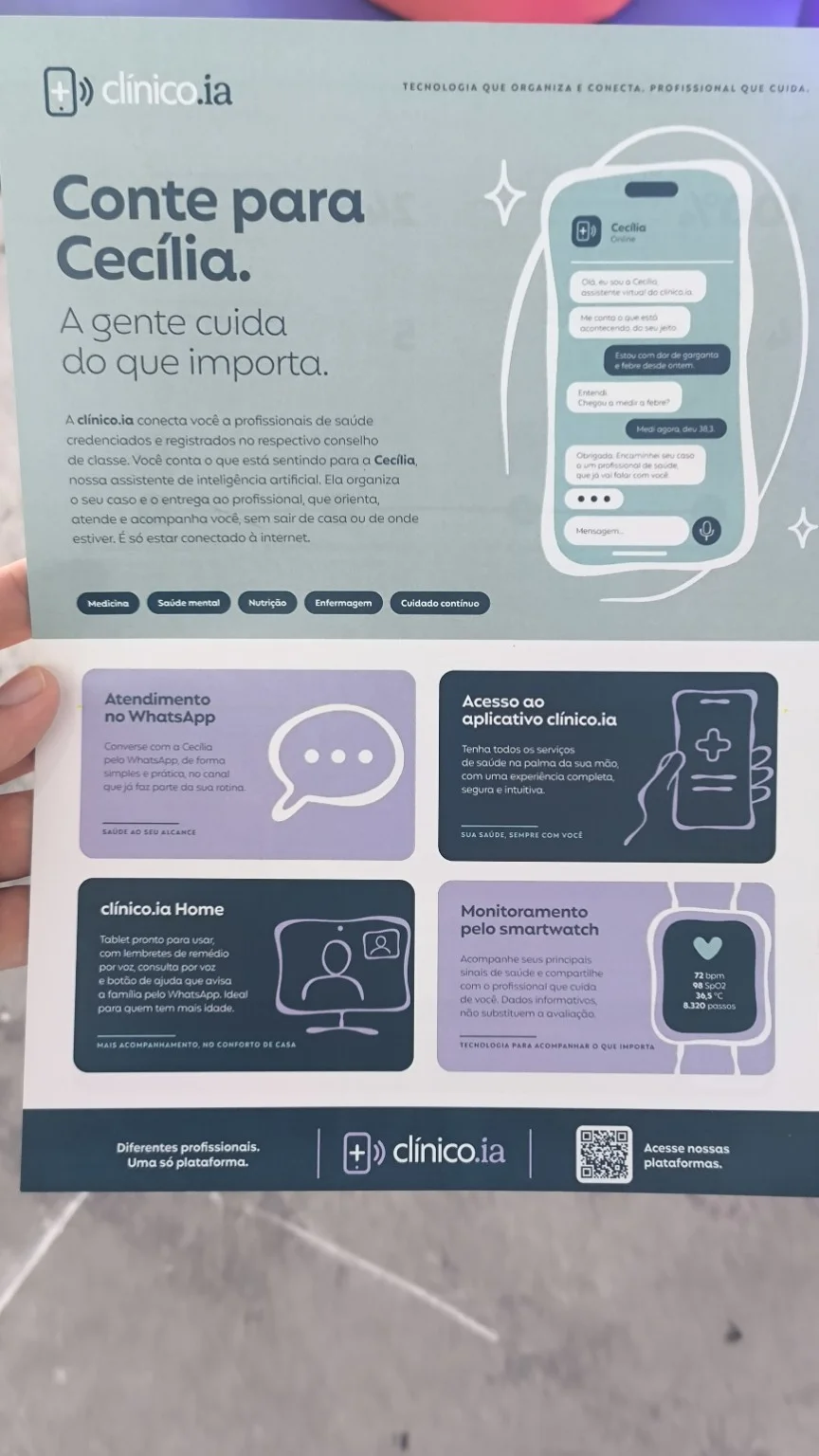
The leaflet describes an assistant that organizes this account and passes it to a professional. As a developer, I am interested in this journey because information changes form at every step: experience becomes conversation, conversation becomes a record, and that record informs a decision. Product quality depends on preserving meaning through those changes.
What the proposal describes
The official app description on Google Play says users can speak or write, their account is organized, and a healthcare professional makes the decision. This is the provider’s description, not a performance test I conducted.
The material I received also presents access through WhatsApp, an app and other devices. That suggests a journey with several entry points. The design challenge is making those entry points lead to consistent information, even when someone changes devices or interrupts the conversation.
A message might start on a relative’s phone. An audio recording might contain a correction halfway through a sentence. An attachment might arrive after a summary is ready. These situations deserve a place in the evaluation scenarios for any service with a similar proposal.
A summary must preserve uncertainty
Consider a hypothetical example: someone writes that a discomfort started “two or three days ago,” then explains that something similar happened before. If the summary turns this into an exact date or removes the earlier episode, it has gained an appearance of precision while losing information.
I would design this stage to distinguish the original account, automatic organization and human correction. The professional should be able to understand where each relevant piece of information came from. The person seeking care could also review important points in plain language without facing an endless form.
This separation helps prevent polished writing from seeming more reliable than its underlying content. Summarization includes preserving uncertainty, negative statements and information that has not yet been obtained. An empty field should not quietly become a negative answer.
The professional handover is part of the product
There is an operational difference between forwarding a conversation and delivering a usable case. In the latter situation, the team needs to find the account, the correct attachments, unresolved questions and the sequence of changes. It must also recognize what the person supplied and what the system generated.
WHO guidance on ethics in healthcare AI emphasizes human autonomy, transparency and responsibility. My translation of that principle into interface design is straightforward: review must be possible and make a difference to the workflow.
An approval button alone does not demonstrate that meaningful review was feasible. I would examine the time needed to check the material, how easily the summary can be corrected, and how a question can be sent back to the person seeking care. These are product decisions that can be explored in a guided demonstration.
Plain language also requires precision
There is room for a welcoming conversation that clearly identifies automation. I would prefer an explicit explanation of who is responding, what will be recorded and when a team member will take over. This helps users form expectations that match the service.
The product also needs to explain the next step. “We received your message” may simply mean the system stored it. “Forwarded for review” describes another stage. “Care completed” should correspond to an identifiable delivery. These states matter to someone tracking their request.
When evaluating an implementation, I would include people who use voice messages, need help typing or have unstable connections. Ease of use in a demonstration does not, by itself, establish how the service behaves under those conditions.
What I would examine in practice
I would begin with fictional cases containing incomplete information, corrections and attachments arriving out of order. I would check whether the final record preserves the account, whether the team can correct it and whether the user understands its progress. Then I would examine how the operation explains access, retention and follow-up.
This perspective connects with my article on AI-assisted clinical documentation. Automatic organization can have a useful role when information remains verifiable by the people who need it.
Cecília provides a case for thinking about that handover. A good experience starts when someone can express themselves and continues when their story reaches the responsible professional in a comprehensible, traceable form.
Sources and further reading
- Clínico.ia: official app description.
- WHO: principles for AI in health.
- Exhibitor material photographed by the author at fswk.rio on November 13, 2026.