QNeuroAI: how to read a proposal for quantum-inspired AI
QNeuroAI’s banner at fswk.rio combines scan analysis, 3D networks and quantum inspiration. Understanding the proposal requires examining architecture, metrics and professional use.
Voices depend on your browser and device; some require internet access. Code blocks are not read aloud.
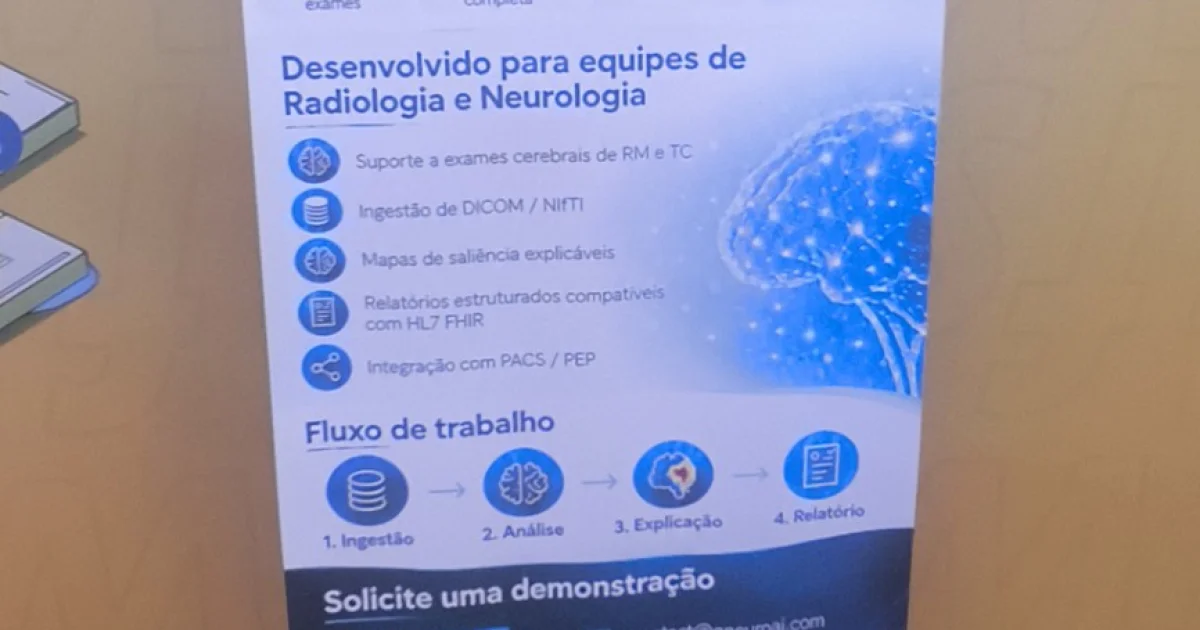
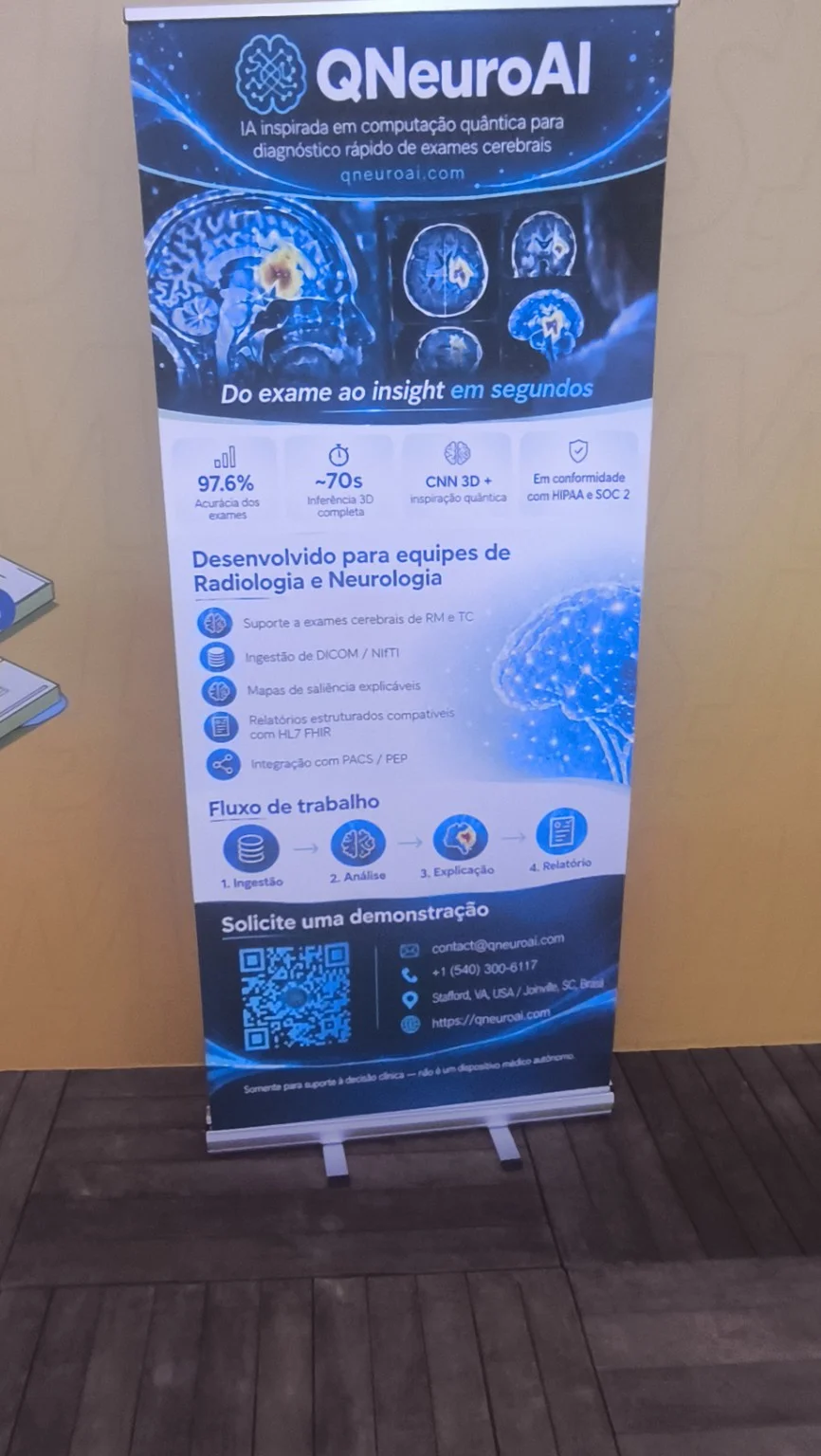
The QNeuroAI banner I photographed at fswk.rio on November 13, 2026 brings together several terms worth explaining: brain scans, artificial intelligence, 3D networks and inspiration from quantum computing. It also presents performance figures and integration with radiology workflows.
To understand a proposal like this, I separate three questions. How was the system built? What was measured to assess its results? How does a professional use its output? These questions complement one another, but answering one does not answer the others.
What quantum inspiration means in this presentation
The QNeuroAI website describes a combination of a 3D convolutional network and quantum-inspired processing, running on conventional hardware. The wording therefore does not establish that each scan is processed on a quantum computer.
That distinction helps frame a technical conversation. I would request a description of the quantum-inspired stage, its input and output, and comparisons with alternatives. The usefulness question is what difference that stage makes to the defined task and under which conditions it was assessed.
An architecture’s name may explain an implementation choice. Understanding its effect requires a comparison with clearly specified experimental conditions. This applies to any component presented as a technical differentiator.
An accuracy figure needs a question
The banner displays 97.6% accuracy. On its website, the company qualifies that figure as internal validation. That qualification must remain when presenting the proposal. It does not, by itself, describe performance across all services, populations and scan-acquisition conditions.
Consider a purely educational example unrelated to QNeuroAI’s results. In a set of one hundred scans, five have a particular condition and 95 do not. A system classifying every scan as negative gets 95 cases right and misses all five positives. Its accuracy is 95%, but the task of finding that condition has not been accomplished.
This example shows why I would examine test composition and error types. I would also ask what counts as a correct result: classifying a scan, identifying an abnormality or another task. The denominator and outcome definition are part of the number.
The scan must arrive under expected conditions
The photographed material mentions imaging formats and connections to radiology systems. To assess integration, I would follow an examination’s complete journey: identification, receipt, processing, review and return of the result.
In a hypothetical situation, an incomplete series or an examination outside the intended scope might arrive. The application should recognize that condition and explain available next steps. Presenting a result without clearly identifying an incomplete input creates difficulties for whoever must interpret it.
I would also examine the association between person, examination and processed version. If material is resubmitted or corrected, staff should be able to locate what was used and distinguish an updated result from an earlier one. That organization supports later review.
An explanation should help with checking
The banner presents saliency maps and structured reports. When evaluating an interface with these features, I would examine how it helps a professional inspect the generated hypothesis. A coloured visualization may be informative, but its presence does not automatically resolve reliability.
Professionals need to be able to disagree, record a correction and access the relevant material. As a design proposal, I would keep automatic output identified and preserve review history. I would also avoid presenting a model confidence level as certainty to the person receiving care.
The good-practice principles published by the FDA, Health Canada and MHRA include evaluating the performance of the human-AI team. This perspective helps examine the workflow beyond the model’s isolated performance.
What deserves a deeper demonstration
I would request cases representative of intended use, including situations where the system cannot complete an analysis. I would examine total working time, corrections and information the professional needs to find outside the interface. These are criteria for understanding operations, not a test I conducted.
I would also keep architecture, clinical quality, security and compliance claims separate. Each requires its own evidence. Promotional material can begin the conversation; documentation and appropriate evaluation help sustain it.
QNeuroAI provides an interesting example of how I read a technical proposal: preserve the provider’s claims accurately, retain qualifications attached to figures and examine the concrete task. Readers gain a better understanding when they can connect the terms on a banner to the work a system is intended to perform.
Sources and further reading
- QNeuroAI: technical description and internal-validation qualification.
- FDA, Health Canada and MHRA: good machine learning practice principles.
- Banner photographed by the author at fswk.rio on November 13, 2026.