A robot at fswk.rio: what to examine when AI has a physical presence
The robot carrying NowPro.ai branding that I photographed at the event opens a discussion about tasks, autonomy, interaction and evaluating technology in the physical world.
Voices depend on your browser and device; some require internet access. Code blocks are not read aloud.
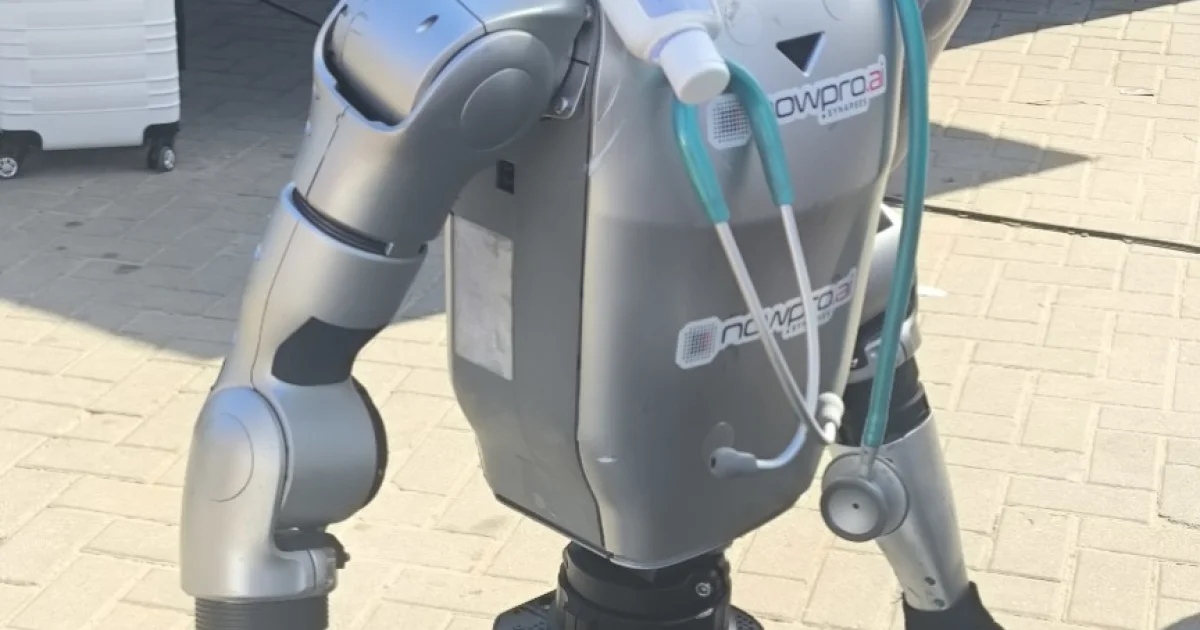
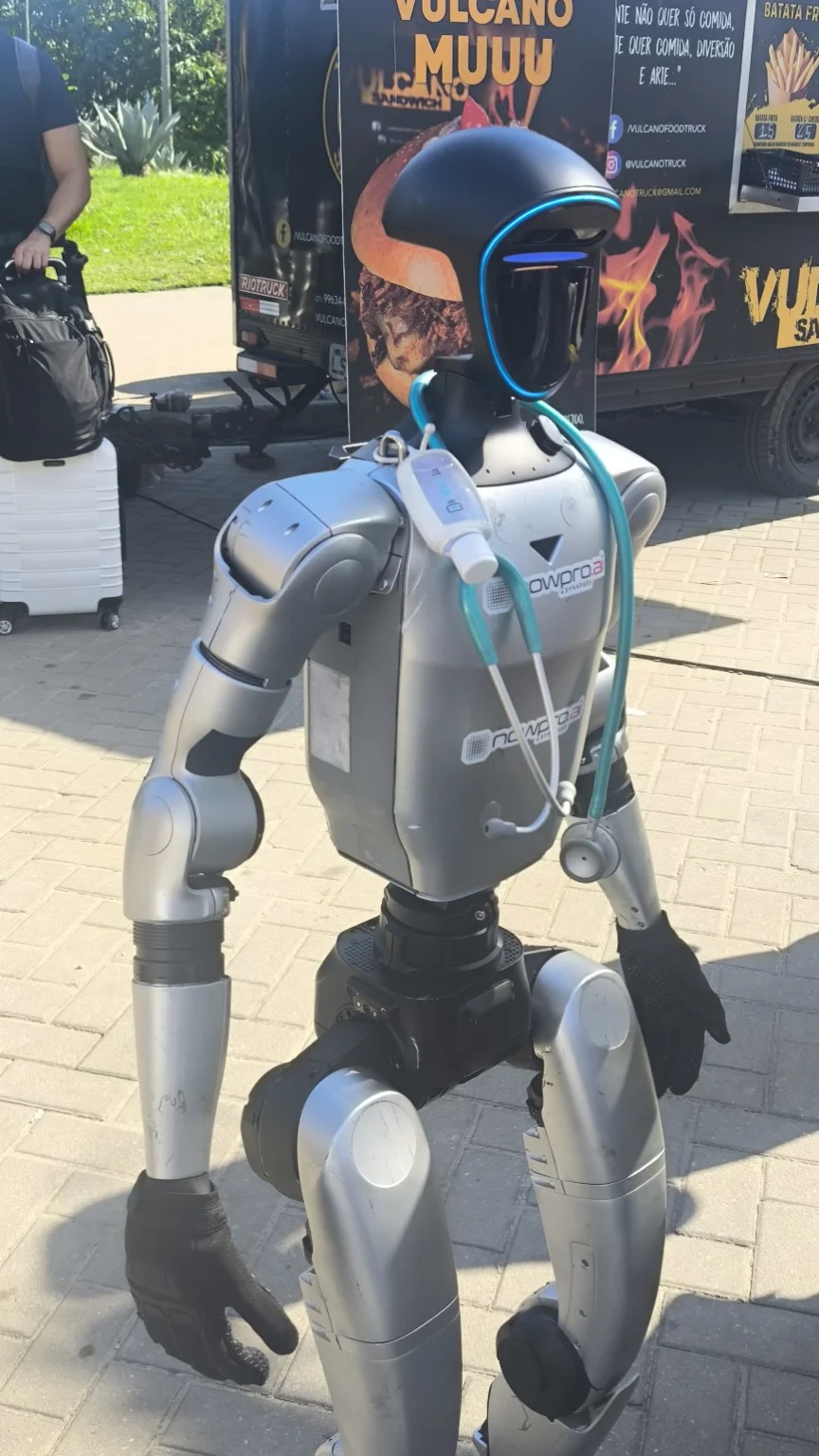
Among the records I made at fswk.rio on November 13, 2026 is a robot carrying NowPro.ai branding, photographed outside the event. Its humanoid shape, blue lighting and stethoscope create an immediate visual association between robotics and healthcare.
The photograph records the equipment’s presentation. By itself, it does not establish its manufacturer, control method or clinical capabilities. My videos also show movement, but do not explain how much of the operation was autonomous. This is enough of a starting point for a useful discussion about evaluating robots in real situations.
Starting with the task makes the discussion concrete
I would begin any evaluation by asking what work is supposed to be done. Directing someone to a room, carrying an object and providing information are different problems. Each needs an observable outcome and a definition of when the task is complete.
Consider a hypothetical reception-guidance example. The objective might be to help visitors find a desk. To determine whether the robot helped, I would observe whether people understood its directions, reached the correct place and could request another form of assistance when necessary.
Appearance would be one part of the experience. The rest would include availability, updated information, intelligibility in that environment and staff involvement. A demonstration can begin that evaluation; routine use requires observing variations.
Autonomy should be described action by action
Calling equipment “autonomous” leaves questions unanswered. Does it select its route? Respond without intervention? Simply replay a sequence? Does an operator supervise and authorize stages? Different conditions may coexist within a single application.
I would ask for a task-level description: who starts it, who supervises, what happens when something unexpected occurs, and when a person takes control. This makes it possible to assess an assisted operation on its own terms without assuming that every action was decided by the machine.
The NIST robotics and autonomous systems programme develops metrics and evaluation methods linked to applications and environments. Its reference context is primarily industrial; it provides a measurement approach, not validation of the robot I photographed.
When software must share physical space
When developing a website, I can start by thinking about screens and responses. Imagining a mobile robot adds other questions: where it stays, where it moves, how it announces an intended movement and how people interrupt an interaction.
In a reception evaluation, I would include occupied corridors, people changing direction, different heights and visitors who prefer to keep their distance. The test plan would need to be developed with the teams responsible for the environment and equipment, under appropriate testing conditions.
I would also examine how the robot communicates its status. People should be able to recognize whether it is available, waiting for an instruction or out of service. Silent, stationary equipment can be interpreted in several ways; design should reduce that ambiguity.
The service continues when the robot stops
An implementation has operating hours, maintenance, content updates and responsible people. I would ask how service continues during charging, connection loss or unavailability. The answer helps reveal the real cost of including the equipment in an operation.
Imagine staff changing a room assignment. How does that change reach the robot? Who verifies that its information has been updated? How long does correcting a direction take? These content-maintenance questions may matter as much to the experience as the equipment’s movement.
Interactions also require consideration. If an application captures voice or images, staff need to explain purpose, access and retention. This should be part of the service description and match what is actually collected. This is not a claim about the sensors or data collection of the robot in the photograph.
How I would compare a proposal
I would arrange an evaluation with a bounded task and a defined period. I would compare correct completion, service time, requests for assistance, availability and staff effort. I would also listen to those interacting with the equipment and those responsible for keeping it running.
The purpose would be to discover the conditions in which the robot adds value. An application may work well in one space and require changes in another. Expansion should follow observed results, with problems and adaptations documented.
The fswk.rio robot provides a striking image for this discussion. As a developer, what I want to understand beyond the photograph is the relationship between task, environment and operation: what the system can deliver, how it explains its limits and how people work with it.
Sources and further reading
- NIST: Measurement Science for Robotics and Autonomous Systems.
- Photographs and videos made by the author at fswk.rio on November 13, 2026.